Opera & Ballet
While opera and ballet offer a rich feast of soaring music, grand themes and exotic settings, they are also stories — about people, strong emotions and the human condition. Clayton Scott uniquely captures these elements through:
- Dramatically presenting the plots, revealing the humanity of the characters.
- Describing the composer’s biography and what happened on opening night.
- Demonstrating the musical devices used by the composer and the singers or dancers to bring the work to life.
- Giving a sense of the historical time and place.
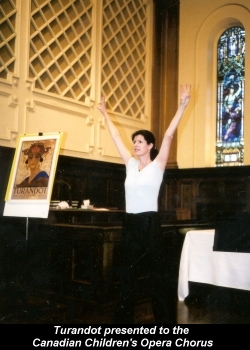
Opera and ballet can reach into the hearts of young and old to teach us timeless truths. About Turandot, an eight-year-old boy said, “Even though it has a happy ending, I don’t think Turandot is a happy opera. The best character [Liu] dies. I think this is a tragedy.” This statement inspired a class of 6–8 year olds to confront the nature of tragedy and apply it, not only to the opera, but also to their own experiences.
Romeo and Juliet shows that music and dance can convey story and truth as eloquently as Shakespeare’s words.
Adults and children come to understand how Puccini’s use of exotic chords and scales contributed to the disastrous opening night of Madama Butterfly. They feel Puccini’s despair, and his ultimate triumph, when this becomes one of the most beloved operas of all time. Discussion follows on intolerance and how history is sometimes a better judge of a work than those immersed in their own culture.
Teenagers play with the “theatrical words” of an opera such as La Traviata: “piangi” (weep), “morro” (I shall die), “sacrifizio” (sacrifice). They become very involved in the dilemmas and the heart-wrenching choices that need to be made. We explore what they would do in the same circumstances.
“My hope is that those who attend a live performance after my presentation will understand the story, the music, the people and the place in history of that opera or ballet. If we are to draw new audiences, old or young, we must make the music feel familiar enough to entice them to sit down and immerse themselves in the experience.”
— Clayton Scott
Presentation titles
These presentations are conducted in a dramatic and anecdotal manner. For young people, it is best if students are grouped by age (6–8, 9–12, 13 and up). Vocabulary can then be geared to the audience. Discussions are lively and age appropriate. All presentations are suitable for adults.
Opera
- Ludwig van Beethoven: Fidelio
- Hector Berlioz: Béatrice et Bénédict
- Georges Bizet: Carmen
- Gaetano Donizetti: L’elisir d’amore, Lucia di Lammermoor
- Pietro Mascagni: Cavalleria Rusticana
- Wolfgang Amadeus Mozart: The Magic Flute, Don Giovanni, Così fan tutte
- Giacomo Puccini: Madama Butterfly, Tosca, Girl of the Golden West, Il Tabarro, Turandot, La Bohème
- Henry Purcell: Dido and Aeneas
- Gioacchino Rossini: The Barber of Seville
- Johann Strauss: Der Zigeuner Baron (The Gypsy Baron)
- Richard Strauss: Ariadne auf Naxos
- Giuseppe Verdi: La Traviata, Aida, Otello, Il Trovatore
Ballet
- Adolphe Adam: Giselle (National Ballet of Canada)
- Léo Delibes: Coppélia (Bruhn/National Ballet of Canada)
- Franz Léhar: The Merry Widow
- Léon Minkus: Don Quixote (National Ballet of Canada)
- Sergei Prokofiev: Romeo and Juliet (Cranko/National Ballet of Canada)
- Pyotr Tchaikovsky:
- Swan Lake (Kudelka/National Ballet of Canada)
- Swan Lake (Bolshoi Ballet)
- Swan Lake (Bruhn/National Ballet of Canada)
- Sleeping Beauty (Nureyev/National Ballet of Canada)
- Onegin (Cranko/National Ballet of Canada)